Every now and then something reminds me to be thankful that I am Muslim.

Even though I haven't actually read any of the Harry Potter series, nor seen any of the movies, and even if their global success has been more the product of some well-designed marketing than of their literary merit, their author has, nevertheless, accomplished something remarkable.
So I thought I'd share an interesting quote from J.K. Rowling that I came across in an unlikely place:
“I stopped pretending to myself that I was anything than what I was, and began to direct all my energy to finishing the only work that mattered to me. Had I really succeeded at anything else, I might never have found the determination to succeed in the one area where I truly belonged. I was set free, because my greatest fear had been realised…I had an old typewriter and a big idea. And so rock bottom became a solid foundation on which I rebuilt my life.”
Ahead of Business Class
Ahead of First Class
Ahead of Executive,
Gold Star, Diamond,
And of course, Super-Elite,
Are special seats,
Reserved for those who fly,
By the seat of their pants.
Because everyone in this section,
Is rushing towards some destination,
The section uses the abbreviation
"SOP,"
To save time.
And many of them are sops indeed,
Dishevelled poets, most of these,
Overcoming their tribulations,
With romantic sentimentality.
But not all of its denizens,
Are inhabitants by choice.
And near them you can sense,
Frustration in their demeanour,
Hurling profanity,
At the connection they missed,
And swearing quietly,
At a loved one they miss.
I am aware that the content of this blog can be a little bit . . . negative. So let me share with you my own feelings of elation today at a story which has no dark underbelly.
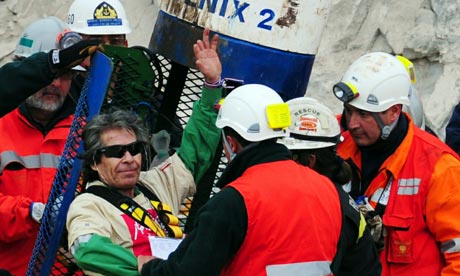
Regardless of how this came about, regardless of what will happen next, I don't think there is a human being on this earth who didn't feel a little pang of relief at hearing that the last miner was out.
In 2000, when the Russian submarine Kursk was reported to be sitting at the bottom of the ocean, the news that all of the survivors of the initial explosion had asphyxiated was profoundly saddening for me. For some reason, I had some special sympathy for all those young men sitting in the dark at the bottom of the sea, waiting for a rescue that ultimately never came. When I heard that 33 miners were trapped at the bottom of a collapsed mine in Chile, I feared a similar result.
Alhamdulillah, this time we got a happy ending.
To all my fanatic followers out there I must apologize for the length of the hiatus between this and the previous post. Things have been busy. Today, however, I will not be delivering any words of wisdom on geopolitics, social justice, the English language, or examples of wingnut depravity. No, today I have something a little more personal to get off my chest.
I'm a big fan of trains. They're efficient, they're quick, they're usually on time (at least the ones I take), they don't often crash, they can move in bad weather, and you can do lots of stuff while riding one. This can't be said about aeroplanes, which guzzle a tremendous amount of fuel, and are often grounded due to weather. It also can't be said of cars, which are still comparatively inefficient, more crash-prone than any other mode of transport, and don't allow the driver to read or work while travelling. In Canada, VIA Rail is a public holding, so you're buying the seat from yourself (unfortunately, the track has been privatized, so your regular fare is a tad inflated).
Anyhow, despite my love of trains, circumstances have recently dictated that I do a lot of domestic travel by car. This month I'll do over 2000km on the highway, with thousands more to come.
On every drive, a certain city has always wound up delaying me, with its 10-lane traffic jams, wherein frustrated drivers crawl along the freeway at 20kph, only to discover after half an hour that the traffic is slowly accelerating to the usual 120kph (because we're all in too much of a rush for the 100kph speed-limit), and with the cause of the blockage remaining a mystery. I have rarely seen any tow-trucks, police cars, or ambulances at the end of one of these slow-downs, so they can't all be for accidents.
But I wander from the point. During one of these little queue-ups, the tendency of most of the drivers is to accelerate to their usual travelling speed, and then hit the brakes when the car in front of them begins looming a tad too large. Even if the space that opens up is less than 50 meters, almost everyone behaves this way.
My philosophy, on the other hand, is to coast. I don't touch the accellerator if I don't think I'm going to go anywhere. So if the car ahead of me lurches forward to 70kph and then screeches to a halt 300m ahead of me, I will take my time to close the gap.
Collectively, we are not going anywhere. At 10kph, I will catch up with that car long before he is ready to embark upon another 200m journey. In fact, I will come to a stop long before I've even closed the gap, because while I am coasting along, fiddling with the radio, or opening a snack, or finding the page where I left off in [i]War and Peace[/i], a whole bunch of type-A personalities from the surrounding lanes will say to themselves "Aha! A gap! Why, that must mean that this lane is somehow travelling faster than the 3 other lanes on this highway!" and fill it in.
While this is happening, some vehicle behind me - it could be a 1979 Camaro or a Volvo 18-wheel tractor-trailer - will see what is going on, thanks to my failure to take advantage of the opportunity to move myself 200m closer to my destination at top speed, and will begin flashing his lights at me. When this, curiously, doesn't work, he begins blasting his horns, in progressively less courteous sequences.
If any of the people to whom I refer above is reading this post, please allow me to explain my behaviour:
When you accelerate, your car gains kinetic energy. This energy comes from the fuel in your tank. When you hit the brakes, you are deliberately dissipating that kinetic energy by converting it into heat. In the process, you are decreasing the life of your engine, transmission, calipers, drums, and discs, not to mention the planet Earth. Your brand new Prius isn't saving the planet if you are slamming on the brakes every 2 minutes.
In doing so, you move yourself less than a few seconds closer to your destination. Yes, you might wind up a few cars ahead of where you might have been, but when we all get back up to 120kph, that difference will wash out. Trust me - I've gently passed lots of people who revved their engines in order to cut me off during the slowdown.
So instead of exhibiting all this excess aggression on the road, to the benefit of no one but car manufacturers and oil companies, take a bit of advice from The Proud Islamist, and exercise a little patience.
Or otherwise, take the train.
In calculus, the second derivative of a function describes the rate of change of a rate of change. So if you're heading east along a highway at a constant speed, the derivative of your position with respect to time would be your speed, and it would be positive, but the second derivative of your position with respect to time would be zero . . . until you accelerated.
Late last year, I became the proud owner of a Palm TX. It was a good purchase, because I've actually used it quite a bit - it stores memos and contact information for me, reference materials that I use often for my work, and local transit schedules. It allows me to surf the internet (if I've got a Wi-Fi signal), functions as a second alarm clock, and I can play chess on it.
The other day, a coworker saw me tapping away on it, and remarked "Don't you feel a little outdated using a Palm, now that everyone's got iPhones and BlackBerries? I mean, tapping away with a stylus?"
I grew up around computers. When I was little, my parents started a small business, building and selling them. Though they've more or less abandoned it now, they still have a few clients who call them for service and upgrades. I was the first kid in my class who could boast of an internet connection at home, which really wasn't much a boast since none of my classmates had ever heard of the internet, much less thought that there was anything cool about it.
Paradoxically though, I have never owned a Discman, iPod, portable gaming device, or any other fashionable piece of consumer electronics. My only phone is of the kind that has no roaming charges. The idea of walking around with electronic equipment wrapped around my head has never appealed to me, and to people who know me personally, I'm sure I seem like quite a Luddite.
Not 300 years ago, if you bought a vehicle, chances were that the horsepower was not that great. Actually, the horsepower was unlimited so long as you could get that many horses to run in step. If it was 1750, and you went to buy a new axel for your the buggy you bought in 1730, nobody said "sorry, they don't make those axels anymore." That's how it had been since the discovery of the wheel and the domestication of the first animals, and that's how it continued until the invention of the automobile (considering that few private citizens have ever owned trains).
My paternal grandfather bought a 1948 Chevrolet Fleetmaster. It is a good car, and I can use the present tense because it is still in operation. The engine has been re-bored and the pistons changed, and it has probably had some other replacements, but it is still essentially the same car; it's the only car my uncle owns.
My parents, on the other hand, have owned 4 different cars since 1978, and have leased a few others in between. People my age seem to get a new one every two years.
A device that I purchased in September is now considered outdated.
"Planned obsolescence" is often lamented as scam, dreamt up by engineers at GM or IBM, or some other large, faceless, blamable corporation as a scheme to fleece the consumer by bringing out a new product every year with totally different components and requirements from the previous year's offerings.
It certainly is a scam, but it takes advantage of our own weaknesses, raised as we are in a consumer-oriented economy, inundated with advertisements from those same corporations. How much better does an iPhone make a person's life? It might be true that using one finger to get directions or send e-mail while "on the go" (the default state of the modern North American) probably does have advantages.
But then, probably not as many advantages as whatever comes out next year.
From award-winning Egyptian-American journalist Mona Eltahawy.
Video.
The auditorium is full of people attending a lecture. Just as it ends a door opens, and a a few people in suits file in, followed by some people in casual clothes with cameras and microphones, followed by more people in suits.
The Management walks in, proud of herself as usual, leading two men with the remainder of their entourage. One is overweight, the other obese. After letting the cameramen position themselves, the Management turns imperiously to the audience, takes a mic, and introduces her esteemed guests: a local representative for the riding in which the institution is located, and the government Minister himself. Now, assuming the air of a tour guide, she explains to the Very Important People what they see before them.
She extols the government's virtuous generosity in having provided money for a public institution; she knows that she must; somewhere, sometime, another Management at another public institution will do the same.
The representative offers his congratulations to the audience on their extensive accomplishments. The audience is used to it. He utters some bland platitudes, pausing for applause. The audience knows the script, and reluctantly obliges. He then cedes the floor to the larger man.
The Minister utters more bland platitudes. The audience again obliges. The Minister then offers some selectively quoted factoid about the accomplishments of his government. The audience obliges again. He is reminded by the Management of his generous offer to the audience: the return of a small sum of their own money.
At this, the audience is thrown into extasies. "I'll clap for that!" says one rube, overcome by the Minister's boundless generosity.
The Minister and the representative are once again thanked, and they offer a formulaic farewell to the audience. The cameras leave, and the players exit stage right.
The props, however, remain.
Dear Sir/Madam,
Thank you for your interest in our programme, reference #J148TK. As there is high demand for J148TK, we would ask you to file the following 32-page application forms at least 9 months in advance of your need for the services. In the event of an emergency, please describe the nature of the emergency on page 6G and file a minimum of 3 months in advance of your needs.
Be sure to attach appendices A-K, as applicable. There will be a surcharge for unnecessary or wrongly filled appendices, in addition to the $300 non-refundable application fee. Attach cheque or postal money order. The surcharge fee must arrive at our office before your application, in order to ensure timely processing and return to you. The surcharge, however, is refundable, provided that you fill out Appendix L and send it to us exactly 17 business days before the rest of your application arrives. Forms that do not arrive on this date will be disregarded, and an additional surcharge will be applied.
You should attach a photograph that is twice as long and 1.64 times as wide as that seen on a Canadian Passport, notarized in both official languages. Printouts are not acceptable. Unilingual notarization is unacceptable, except for foreign businesses with operations in the Former Yugoslavia. We suggest that you seek out a bilingual notary in advance of filing your application.
Please ensure that your immunizations are up to date and that you are immune to Varicella, Tetanus, Rabes, and Ebola. Documentation of this, with the seal of two physicians, a public health nurse, and a chemotherapy patient will be required. Although we recognise that Ebola outbreaks are rare amongst participants in J148TK, we need to cover our asses, and we know you understand. If you are currently carrying, or have carried, Bubonic Plague, then please file Appendix M. If you have not carried Bubonic Plague, then we encourage you to file a concurrent application to Programme #J148TL, to maximize your chances of success. Please see the responsible office (Miscellaneous Services Office) for more details.
Please also attach a detailed Curriculum Vitae, with references to past experiences in the following areas: Public Sector Experience, Private Sector Experience, Selected Publications, and Ice Fishing Experience. Please provide a verifier for each of these experiences, with an attached photograph and signed affidavit. For Ice Fishing, the provision of a dead fish by courier with a photograph of the fateful moment is acceptable. Please ensure that the fish is not enclosed with the rest of the application, and to save us the stench, please do not file more than 12 months in advance of your needs.
Otherwise, a surcharge will be applied.
For further information, please dial the number available by following the labyrinth of links on an unrelated, unspecified website.
Cordially,
The Office of Miscellaneous Services.
Human solitude is dying.
"Every time I dropped this cell phone I would pick it up, hoping that it was broken, and every time I was disappointed." I said this to the dismay of the person who had insisted I borrow it - with completely good intentions, I might add.
Human solitude is dying. When was the last time that you can remember spending a full 24 hours, or even 12 hours in the absence of anyone else? When was the last time you threw down your Blackberry, your cell phone, your laptop, your pager, your PDA, your carrier pigeon, and every other method of communication, and allowed yourself to be alone?
When was the last time you left the city, left civilization, and went out alone into the woods, the prairie, the desert, the savannah, the tundra and didn't return for hours?
For those of you who are regular hikers, the answer very well might be "yesterday," especially if you live in Canada and you've had good weather recently. I'm not a regular hiker, and neither are most of the people I know. Neither are most of the self-declared environmentalists I know, myself included. We're intent on saving God's green Earth, but not to keen to experience it on our own.
"On your own," is important, not because it represents some kind of rugged individualism, but because it is so rare these days. We are never truly alone these days, as human beings create newer and more intrusive ways of contacting one another. In 1995, how many of your day-to-day acquaintances owned their own cell phone? In 2005, how many of your friends didn't? That's an unprecedented change. As cities expand, other places - places that are not cities - necessarily contract. There is less space to be alone in, and what is left is less accessible to the average person.
As I sit here typing away on my laptop, with its wireless internet connection, some of you might be thinking "now isn't he quite the hypocrite!" The answer is partly "yes," as the last time I recall being so alone and out of contact with humanity, and so in contact with the rest of Life (with a decidedly capital "L") would be at least a year ago. I am, however, not suggesting that we all renounce electronic gizmos and run off to the jungle, to live as hermits in rabbit-skin underwear. The telephone and the computer are useful inventions, and human beings are social animals. They just shouldn't become the focus of our lives; we should be able to live without them. We should be capable of being by ourselves.
Now many of you are probably thinking "Here goes another one, trying to make us feel bad for not spending enough time outdoors."
You'd be right. I am doing that. The important thing, however, is that you do it alone, and for an instant, be alone with your own thoughts, and not only ressucitate, but cherish that solitude.
That is the example of sages and prophets who came centuries before us, and it is one that - I suspect - we are quickly forgetting.
To me, one of the great mysteries of human life is the phenomenon of jewellery. It is common to all societies that I know of (and, by extrapolation, probably a great many that I don't). From bracelets to nose-piercings, it is also an ancient custom. Some jewellery serves a ceremonial purpose, or serves as a formal indication of status; other jewellery is purely decorative, and indicative of nothing more than the tastes of the individual. In most cultures of the West, plus a couple of the East, a wedding ring is a sign that a man loves a woman enough to part with a substantial quantity of money.
Beyond, however, that particular ritual, I don't understand the compulsion of people to make, buy, or wear jewellery. Now, nobody needs a 48" plasma screen TV, but at the very least, you can watch TV on it, and one assumes that to whoever buys such a thing, the picture is worth it. What exactly can you do with a $400 necklace?
A gold Rolex watch glitters a bit more than a $30 RadioShack special (oh, for the days of RadioShack!), but it offers relatively little improvement in its accuracy, and at any rate, most people buying watches don't need to-the-millisecond timing. The Rolex might last a bit longer, but the cost probably doesn't justify it.
So what is the human attaction to things that glitter?
In some cases, it probably remains a sign of status, not unlike a Mercedes or a Rolls-Royce. The majority of people driving such cars do not need them, and the advantages likely do not outweigh those of a VW or a well-built Subaru. Still, they serve some function, they're useful, even if only slightly more so than other vehicles. What function does a platinum ring serve?
I can intellectualize and theorize about jewellery, but I'm not sure that I will ever truly understand the desire to own it, or to buy it, or to wear it. I suppose that in the end it is one of those things that must be experienced in order to be understood.
I certainly hope I never do.
"Is nothing sacred?"
The phrase is often said jokingly, to express hyperbolic disgust over the transgression of some minor tradition. "Pizza with artichoke on it? Is nothing sacred!?" Really, though, what do we have today that IS considered sacred?
That less and less is actually considered taboo in most Western countries is considered by some to be a good thing. I generally agree - this is almost part and parcel of the freedom of expression. The tearing down of taboos means the opening up of new avenues of social and political discourse. We are free to talk about teen pregnancy, STDs, racism, sexism, and abuse of power by all traditional authority figures. We are free to make asses of ourselves, just as much as people are free to point out how assinine we are.
Shock-value entertainment thrives in this environment. Want to see women fight over a wealthy man? Tune in every Wednesday night at 8. Want to become an overnight celebrity? Write a book insulting a religion. Want to make your movie a box-office hit? Gore and sex are your guarantors, but please, go further than the last movie did.
I don't claim that this is new. For the Romans, watching people kill eachother or be torn apart by lions was also wholesome public entertainment. That said, where in "Western" civilization do we find reverence anymore?
There are some topics that still cannot be mocked or exploited for public entertainment. It's still considered bad taste to make fun of victims of domestic abuse or sexual violence. War veterans and cancer patients are also considered above reproach. This is not reverence, though, this is pity, or in the case of veterans, respect.
As for religion, those doors seem to have been flung wide open. Prophets, scriptures, saints, icons, and the Almighty himself are not spared. To ridicule religion seems so overdone that it is cliché.
Today, irreverence is impossible, because that would imply that there was something we revered.
I am not sure that this is a bad thing. If we are free to criticize, then we don't have to hide the thoughts that we might have been silently concealing, and by expressing them we give ourselves the benefit of hearing the response.
That said, reverence is not just a quality of the revered, it's also an emotion that we feel. I wonder what would happen to a society where no one ever felt it.